




Liz West in-conversation with Francis Pearce
2016
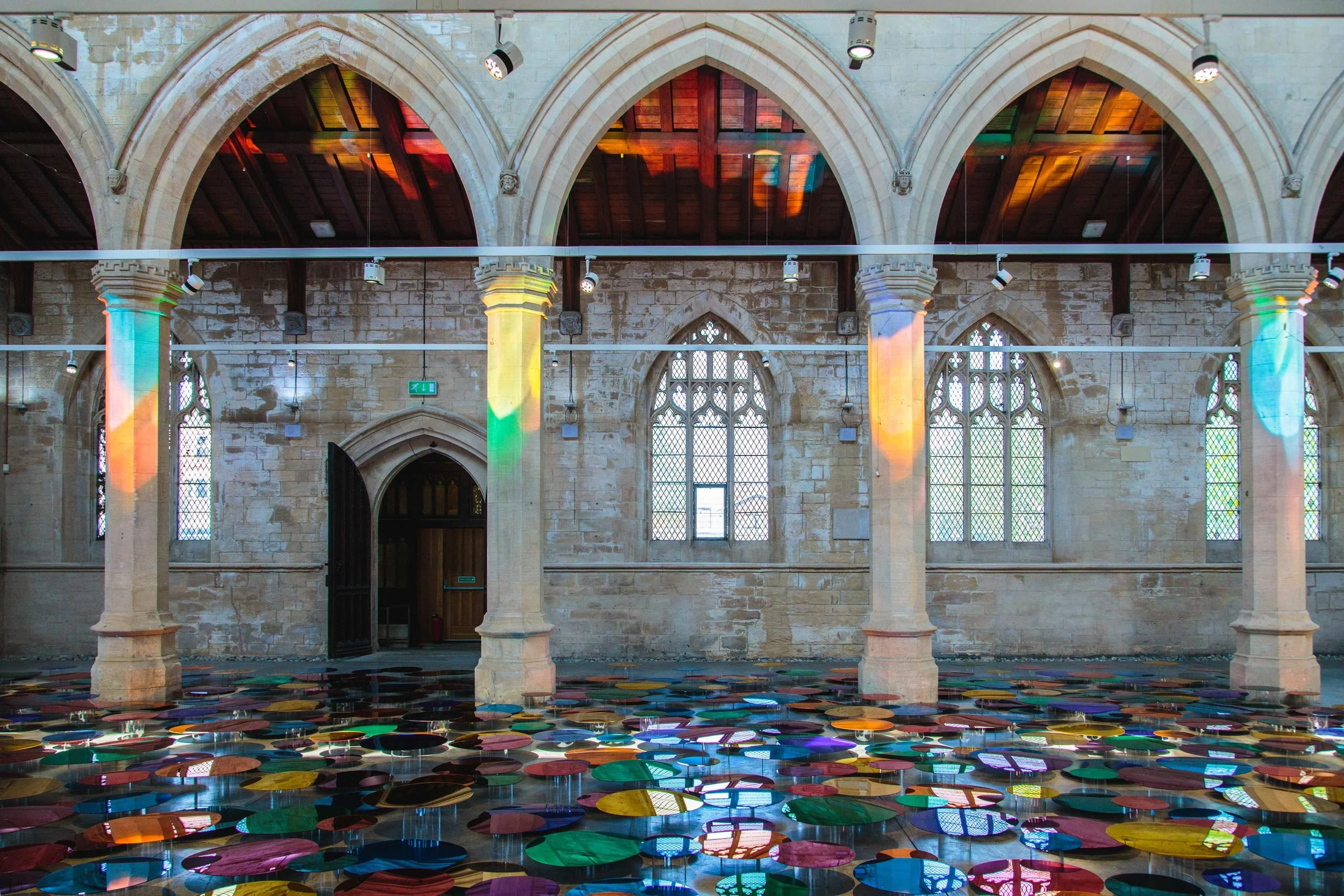
The idea that we only use a tenth of our brains has had currency as an urban myth for about a century. In reality, we use most of our brains most of the time and at least a third of their area is devoted to visual processing. There is more to seeing than meets the eye, not only in the way our brains interpret and interpolate the tiny, discrete samples of visual information they receive, but also how we react to what we see, subjectively and emotionally. Colour, in particular is a complex and puzzling area for investigation. As an artist using light as a medium in its own right, Liz West creates vivid environments that mix luminous colour and radiant light to provoke heightened sensory awareness in the viewer. Her latest work, Our Colour Reflection is a large-scale and site-conditioned installation using coloured mirrors and natural light to explore deeply entrenched relationships to colour, space and time. Although most of her work to date has mainly played with artificial light, Our Colour Reflection sees her working ‘unplugged’, taking inspiration from the original architectural design of the 20-21 Visual Arts Centre in Scunthorpe. By referencing the site, with its expansive windows drawing light in and around the space, and its history as the former church of St John the Evangelist, this ambitious work encourages viewers to question their surroundings and consider the work’s relationship to the architecture it inhabits. ‘I like to work in a direct and responsive way to the light, space and architecture of whatever site I’m working on,’ says West.
West studied Sculpture and Environmental Art at Glasgow School of Art. In her final year, she began working playfully with natural and artificial light sources and projection. ‘Colour and light became my voice’, she recalls. ‘Light quality is central to my understanding of the world and well-being; when I chose to become an artist there was little doubt that the use of light and colour would eventually creep into the process, presentation and concept.’
The minimalist ‘neon’ (actually fluorescent) sculptures of Dan Flavin provided early inspiration. Flavin stuck rigidly to the narrow size range of tubes and choice of colours available in factory-standard fluorescent and famously stated that his art ‘is what it is and it ain’t nothing else.’ And yet it transformed the spaces it was designed for. West says that what she ‘became most interested in are the quality of light and the use of the vivid end of the spectrum, chemical colours, the colours you see in neon, the colours you see in cities and the way a neon urban environment can envelop you.’
Much of her recent work is informed by research into colour fields and the title An Additive Mix was a reference to Josef Albers’s seminal publication, Interaction of Colour. ‘Subjective mixtures of colours are core to my understanding of colour and have helped shape the backbone of my practice, but it is my ongoing investigations into additive mixtures that inspire the work,’ she explains. ‘I am not attracted to surface colour like I am to luminous colour, hence not being a traditional painter.’
Other artistic influences include David Batchelor and Jim Lambie whose brightly coloured vinyl floorwork and light tower, she first saw together at Tate Britain in London in 2003. ‘From a very early age I knew that the type of work that I enjoyed were installations where as a viewer you were immersed within a colourful or light-based environment,’ she says. But perhaps her most important formative experiences as an artist was encountering the immersive Skyspace installations of James Turrell at Yorkshire Sculpture Park, where she worked while still a student. Turrell usually works on a large scale – massive in the case of his Roden Crater, an old volcano – but, more importantly, he focuses on the phenomenon of light, on sensations, consciousness.
There is a similar balance in the way that West’s work is informed by an understanding both of the observations on optics of Sir Isaac Newton and of the musings of the German philosopher Goethe on our perception of light and colour. Lincolnshire-born Newton is regarded by many as the last alchemist; among other things, he was a believer in transmogrification, the magical transformation of matter. His analysis of the nature and behaviour of light, though, has formed the nub of our scientific understanding for centuries and his notion that light comprises ‘corpuscles’ is remarkably close to current explanations enshrined in quantum physics. In one experiment, Newton shone white light through a prism set at an angle so that the light bent and refracted splitting into different wavelengths visible as colours. He had unwoven the rainbow. Then, he put that disassembled light through a second prism. ‘The event was, that the light, which by the first prism was diffused into an oblong form, was by the second reduced into an orbicular one, with as much regularity as when it did not at all pass through them,’ he wrote. In other words, he turned it back into white light, and that was his genius.
Goethe’s theories on colour and light reflect a different, perhaps less rational and certainly more subjective view of light as something we experience, something that transforms us. West’s synthesis of these two streams results in works that alter spaces and our experience of them.
‘My investigation into the relationship between colour and light is often realised through an engagement between materiality and a given site,’ she says. ‘Within physical and architectural space, I use light as a material that radiates outside of its boundaries and containers, playfully refracting light through using translucent, transparent or reflective materials, directing the flow of artificial and natural light. Our understanding of colour can only be realised through the presence of light. By playing and adjusting colour, I bring out the intensity and composition of my spatial arrangements.’
The work that most directly led to this important solo exhibition at the 20-21 Visual Arts Centre was her installation at the National Media Museum, Bradford. An Additive Mix formed part of Light Fantastic, the museum’s contribution to the UNESCO International Year of Light in 2015. For it, she built a 10m x 5m mirrored space whose ceiling was covered with 250 fluorescent lamps individually, and painstakingly, coloured and wrapped with gels. More than 130,000 people had the experience of viewing them combine to create the experience of white light.
Our Colour Reflection creates a conversation between the viewer and the setting using more than 700 mirrors made of coloured acrylic. There are 15 colours in all and the mirrors with diameters of 30, 40, 50 and 60cm are set at different heights so that they both reflect the roof space of the old nave, revealing parts of the architecture that would otherwise be invisible, and project colour up into the historic interior. It is playful, elegant and engaging but also thoughtful. Taking time to research and consider the history of the building and the weight of connotations it holds as a former place of worship, West has thought about stained glass and the importance of light within the space. ‘This has allowed me to make sure the work is grounded within its site but also holds its own voice within the grandeur and information that the space brings to the conversation,’ she says.
There is an element of performance to this work; it puts the audience to the fore, demanding a response, in West’s words ‘physically, emotionally, psychologically or even spiritually.’ Viewers will each have their own perspectives and their own experiences tempered by movement through the space and through time. By going unplugged here, West emphasises that while artificial light can be manipulated it can only, at best, replicate the dynamism, shifting mood and changes in quality embodied in natural light. ‘Light has always been a pivotal element within my life,’ she says ‘It is an entirety that my whole life has centred around, not just my work. I notice even the slightest light changes during the daytime, which affect my emotions and psychology drastically. Sunlight and weather conditions affect me emotionally and mentally and the effect of light is always central to my work, and always would be, even if the work itself is not directly light-based, because it’s so important in how it affects the nature of the space and the viewer’s perception of the work.’
Francis Pearce is an editor and writer for publications including Lighting –Illumination in Architecture, Blueprint, Apollo and Vogue, in addition to producing fiction and screenplays.