

Liz West in-conversation with Derek Horton
2015
Anyone familiar with the colourful and light-filled work of Liz West would enjoy the coincidence that the route to her Manchester studio takes the visitor along Sparkle Street. The small studio is on the top floor of a large old industrial building. Even under Manchester’s cloudy sky, daylight streams through multiple coloured filters on the windows.
An airy bright space, the studio is too small for West to build the immersive projects for which she has become known. But she says it represents, “a clean space where I make preparatory studies and drawings – a place to think and visualise but one that isn’t big enough even to make maquettes to the scale and ambition I would want. That works for me though because I like respond directly to the light and space and architecture of whatever site I’m in, so when those kind of large-scale projects are underway, the studio is just a place for conceiving and planning things out rather than actually making. I have a different kind of energy when I’m in the space where I know I’m going to have an audience. In that ense I’m a performer, and the world out there is the ‘stage’ where I’m happiest, whereas the studio is a much more personal environment, more private, and quieter – a place to rehearse ideas or to which I can retreat.”
We talk more about West’s way of creative process, the balance between careful planning and intuitive inspiration. She explains “I visualise my projects very clearly. I know what I want to achieve and I’m a perfectionist, so if the making process doesn’t result in the idea in my mind’s eye, it has to be refined or even changed completely until I can realise what I imagined. So the plan for what the work will look like doesn’t change but the plan for how I can get it to look as I want it sometimes has to!”
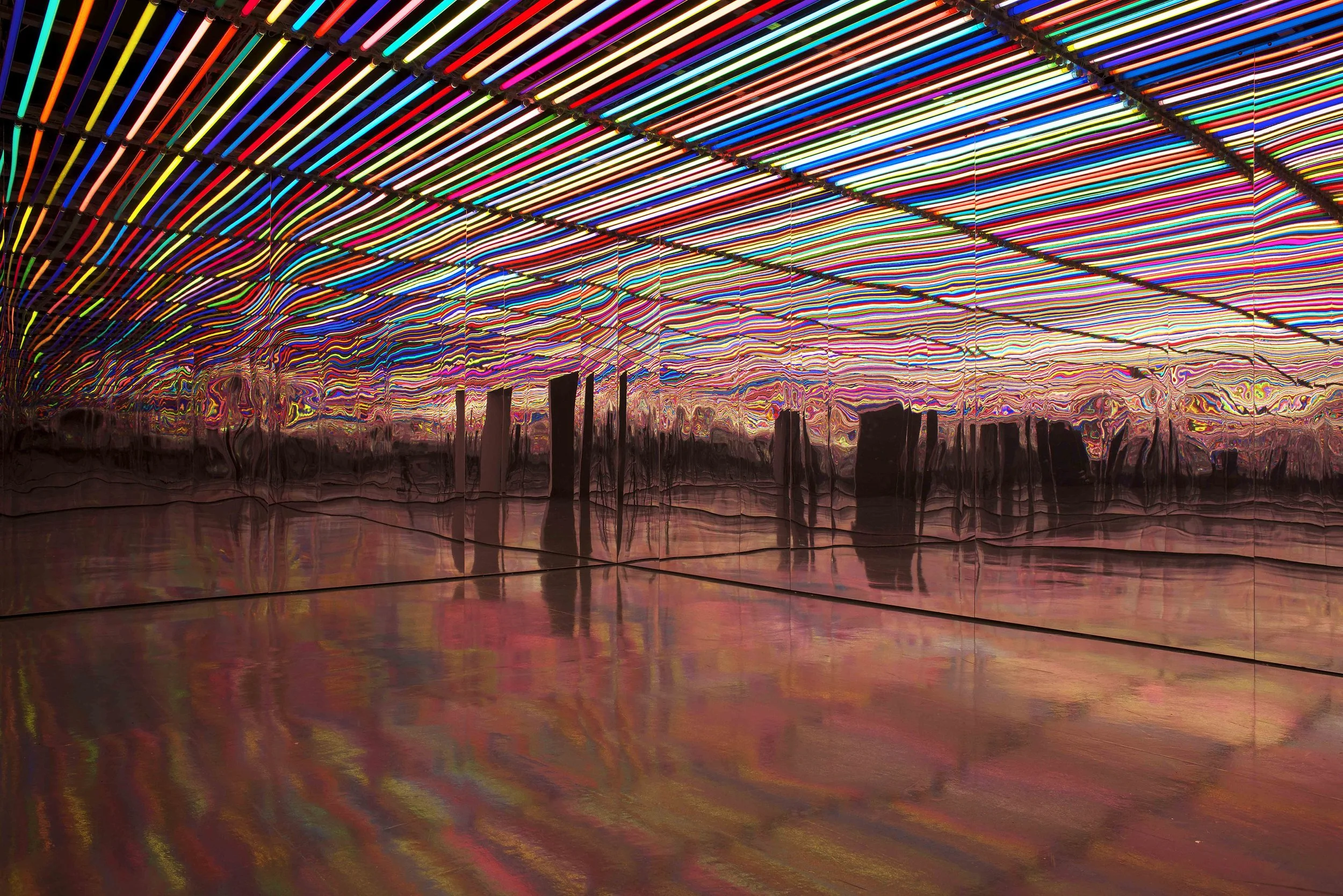
All sculpture, especially when made and sited outdoors in relation to architecture or the landscape, changes according to the time of day and prevailing weather and everything else that affects the light conditions, but that is not necessarily something that most sculptors have in the forefront of their mind. Certainly not as much as West, precisely because her sculpture is often made by utilizing light or is dependent on light – or even its absence. For an artist making a 3-dimensional object, the stronger the light, the stronger the image, but sometimes for West, who often uses artificial light as her material, the opposite is true, and it comes truly into its own only in the dark. The presence of too much extraneous light can render her sculpture invisible, so I suggest to her that she has to think of light in both positive and negative terms, West agrees: “Yes, I’m always waiting till it gets dark to see how it changes. Sunlight and weather conditions affect me emotionally and mentally and the effect of light is always central to my approach, and always would be, even if the sculpture itself is not directly light based, because it’s so important in how it affects the nature of the space and the viewer’s perceptions. I always want to make things that are effective in both night and day, but obviously that means the works changes constantly, as well as the ways people react to it. In daylight they are always more sculptural, and then somehow they take on a different kind of presence and become more immersive in the dark.”
Thinking of the sculptural nature of West’s projects, their scale, the physical engagement with materials, the building process, all of this work that lies behind the image isn’t always visible. The physicality of her making process is often hidden. With Through, at &Model in Leeds earlier this year, for example, what the audience saw were flat coloured surfaces in the windows, but inside those windows, behind the scenes, was a whole other, much more 3-dimensional physical structure (can you describe it please). The visual spectacle is thoroughly dependent on a sculptural process, but one that often remains ‘behind the scenes’. Illusion therefore, plays a big role, particularly in the current mirrored pieces.
“I’m always trying to make the viewer question what it is that they’re looking at”, West says. “To some degree, my projects have to be presented in a very slick way to maintain an illusion. At other times though I have explored and revealed more of the ‘behind-the-scenes’ aspects, the entrails, which have a different kind of theatricality of their own. The piece Vanishing Boundaries, for example, is derived from a drawing and so the cables became part of a kind of drawing in space. In other pieces, they would be hidden because they aren’t part of the piece and would disrupt its effect.”
“The things that I became most interested in are the quality of light and the use of the vivid end of the spectrum, chemical colours, the colours you see in neon, the colours you see in cities and the way a neon urban environment can envelop you.” Despite this, in some of her most recent and upcoming commissions, West has, as she put it, “been thinking beyond the plug”, and she is developing pieces where sunlight rather than electric light is the source. She describes a ‘coloured sundial’ in a gallery roof in London, and a Natural England commission for Ainsdale Forest saturating the forest floor with dappled sunlight filtered through multiple coloured strips strung between the trees.
Clearly, an informed understanding of optics and Newtonian physics and Goethe’s theories of visual perception underlies West’s playfully intuitive approach. However, it is the colour theories of Josef Albers, manifest in his paintings, and even more in his Bauhaus teaching, that remain her most frequently mentioned influence and inspiration. It is significant that Albers taught colour theory predominantly by getting his students to use coloured papers rather than paint, encouraging the idea of colour as a physical presence, a material to be manipulated. It’s also not hard to see the influence of 90s pop videos with their bright and intense colours and make-believe worlds, and indirectly 60s psychedelia too. Indeed the spaces that West infuses with light feel they could easily be animated further by sound or dance.
Those influences and that kind of ‘performativity’, the physical engagement of both artist and audience, are relevant to the cultural accessibility and spectacle of West’s projects. Their photogenic qualities make her colourful installations instant hits on social media. Although her sculpture is made and sometimes shown in a contemporary art context it is often seen outside of that context by casual passers-by or in sites such as the National Media Museum by much more diverse audiences, I ask her how she feels, as an artist, about the ‘entertainment- value’ of her projects. “I think luminous colour and saturated light are both universally understood and enjoyed. My way of making art is appealing to people. Children are playful in it and adults bring other dimensions to it through their feelings and emotions in a very open way that rarely happens in contemporary art. I like that, in fact I’d like to do more research into colour and its emotional impact on people. I think I’m very playful, I love the idea of making an accessible spectacle with an immediate appeal. That’s an aspect of my practice that brings me real pleasure and joy.”
Derek Horton is an artist-writer, curator and former teacher.